The Edge Was Never the Setup: An AI Trading System Run in Public
Discipline and Protocols
I built a trading system that is run by an AI, governed by a written constitution, and operated in public on a real account. In its first week, the market offered it six classic ways to lose money. It took none of them. Here is what we built, how we built it, why we built it, and what that first week actually proved.
Most trading content sells you a setup. A pattern, an indicator, a "secret" that supposedly prints money. I have been around long enough to know that is the wrong end of the problem.
The uncomfortable truth, the one my book Trade Calm is built around, is that strategy is maybe 10% of trading. The other 90% is execution under pressure: holding the line when you are afraid, not chasing when you are greedy, sizing your fiftieth trade exactly like your first, and being able to do nothing when nothing is the right move. That is where almost everyone breaks. Not because they do not know the rules, but because in the heat of a live market, a human nervous system quietly renegotiates them.
So I asked a different question. If the hard part is not knowing the rules but executing them without flinching, what happens if you hand the execution to something that cannot flinch?
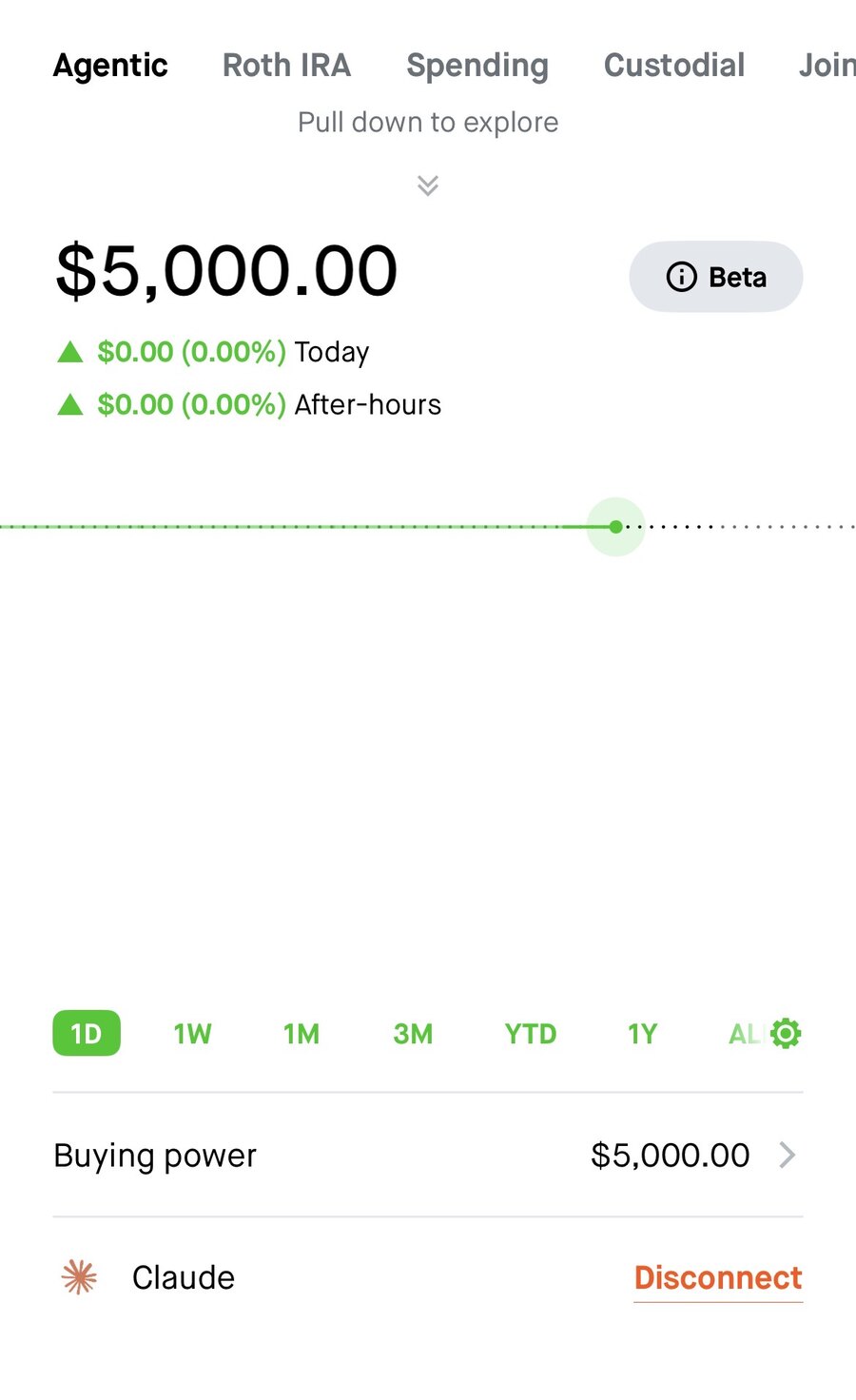
That is the experiment. An AI agent (Claude) operates a rules-based, long-only swing trading system on a small, dedicated real-money account I am fully prepared to lose. Every rule was written in advance, in a calm state, before any trade. The agent analyzes, proposes, and executes only inside those rules. I approve every trade in this phase. And all of it, every decision including the decision to do nothing, is tracked in the open.
No hype. No guru returns. And most importantly, no assumption that it even works.
What we built
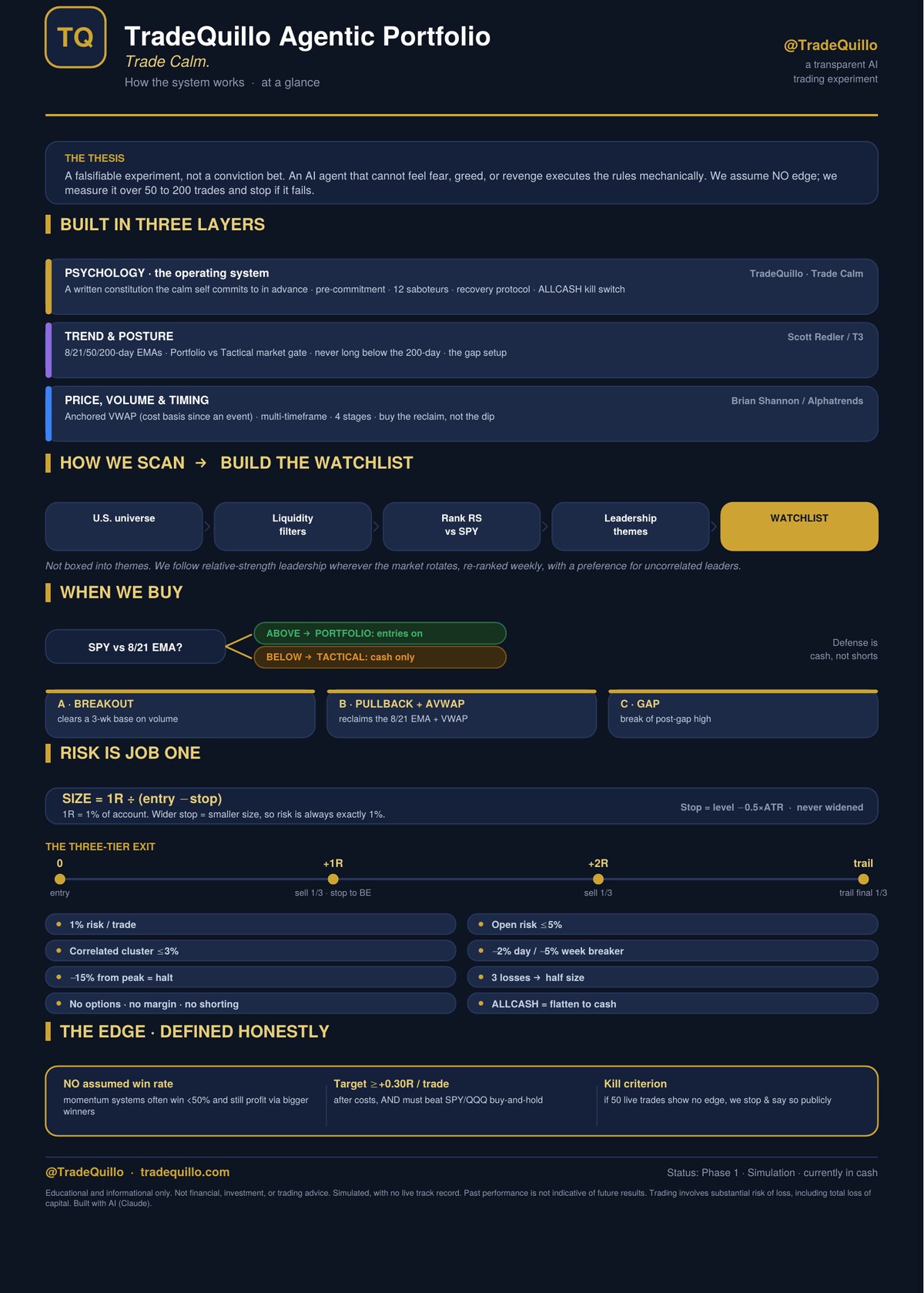
The heart of the system is not an algorithm. It is a constitution: a written document that the calm, rational version of me committed to in advance, so that no in-the-moment version of me, and no in-the-moment impulse of the machine, can override it. Ulysses lashed to the mast, except the mast keeps a change log.
The trading rules themselves are deliberately boring, which in this business is a compliment. The system trades U.S. stocks and ETFs only, long only, on the daily timeframe. It hunts whatever sectors are showing genuine relative strength right now, rotating as leadership rotates instead of marrying a favorite theme. It has exactly three entry patterns: a breakout from a tight base, a pullback that reclaims support on a closing basis, and a continuation after a news gap. Every position risks 1% of the account, with a hard stop placed before entry and never widened. A market posture gate decides whether it is allowed to hunt at all: when the broad market trades above its short-term trend, entries are permitted; when it is below, the system goes to cash and stays there. Defense is cash. Not shorts, not hedges, not options. Cash.
Winners are scaled out in thirds: a third off at one unit of risk with the stop moved to breakeven so the trade can no longer lose, a third at two units, and a final third trailed along the trend until it bends. Losers are capped small and taken without negotiation. Layered circuit breakers halt the machine after a bad day or a bad week, a drawdown limit protects accumulated gains, and a recovery protocol forces a cooling-off period and a staged rebuild instead of revenge trading. There is also a kill switch: one word, ALLCASH, and the agent liquidates everything to cash instantly, no questions asked.
The agent answers to exactly three commands. UPDATE runs a full thirteen-step assessment and produces a numbered plan; it can never place a trade. EXECUTE carries out the most recent plan, only during market hours, only after re-validating every condition, and it skips anything that has drifted rather than chasing it. ALLCASH is the eject handle. That is the entire interface. There is no "just this once."
How we built it
I did not invent a strategy. I stood on the shoulders of people who have done the work, and took only what fits a disciplined, long-only system.
From Trade Calm came the operating system: the constitution concept, pre-commitment, hot-state safeguards, the recovery protocol, and the rules that bind me, the human, just as tightly as the machine. There are clauses that block new trade approvals when I am sleep-deprived or stressed, that pause everything if "make it back" language shows up, and that route every mid-week "improvement" idea into a queue that can only be ratified at a scheduled weekly review, with a cold head, at least 48 hours later.
From Scott Redler of T3 Live came the trend framework: the 8, 21, 50, and 200-day moving averages as the map, the market posture gate, the refusal to ever own a stock below its 200-day average, and the discipline of never holding a position through its earnings report, because an after-hours print can gap straight through any stop and there is no risk management on the other side of it.
From Brian Shannon of Alphatrends came the price lens: anchored VWAP, multi-timeframe stage analysis, and the single best entry lesson in the system: do not buy the dip, and do not chase the breakout. Buy strength when price reclaims the level where the last buyers got trapped. Confirmation, not hope.
From Alan Farley's The Master Swing Trader came setup quality: favor breakouts that emerge from a volatility contraction, the coiled spring, and obsess over entry location, because a good trade taken in the wrong place becomes a bad trade.
And here is the part I did not expect: the AI was not a passive scribe while we built this. It argued. When I floated the win rates I was hoping for, it refused to write any assumed win rate into the system at all, because hope is not data. When I brought up Fibonacci retracements, it talked me out of them, on the grounds that they add false precision and a surface for rationalizing trades. When I asked about hedging with a leveraged inverse fund, it walked me through volatility decay and made the case that the honest hedge for a small, nimble account is cash. When I proposed one position size cap, it negotiated me to a better one with arithmetic. The finished document then went through a full audit, formal amendments with a change log, and a freeze, so that what we measure from here is one fixed system and not a moving target. Everything was decided cold, on purpose, before the market could make any of it emotional.
Why we built it, and why in public
Two reasons. First, accountability: it is easy to be disciplined in a backtest and very hard in real time, and knowing every decision will be visible changes behavior. Mine included. Second, honesty is the entire point. The trading world is full of people showing you their winners and hiding their account statements. I wanted to build the opposite: a falsifiable experiment, run in the open, where the method gets a fair trial and we report what actually happens, good or bad.
Falsifiable means exactly this. "Edge," in this experiment, is a positive expectancy of at least +0.30R per trade after costs, measured across 50 to 200 trades, while also beating a simple buy-and-hold of the index over the same period. An active strategy that cannot beat just owning the index is not worth the risk or the effort, and if that is the result, we will call it that. And there is a kill criterion: if, after 50 real trades, the expectancy is zero or worse, the method is declared falsified, publicly, and we stop. No quiet strategy-hopping to keep the story going.
We do not assume a win rate. Not 50%, and certainly not the 60 to 80% people love to imagine. Momentum systems often win fewer than half their trades and profit anyway, because the winners are larger than the losers. So we do not guess. We measure. The most likely outcome while the sample builds is roughly breakeven, and the account is risk capital. Judge the experiment on that basis.
Week one: six ways to fail, zero taken
Here is what makes this announcement different from the one I almost published a week ago: the system now has a live week behind it, and the market chose a spectacular week for a stress test.
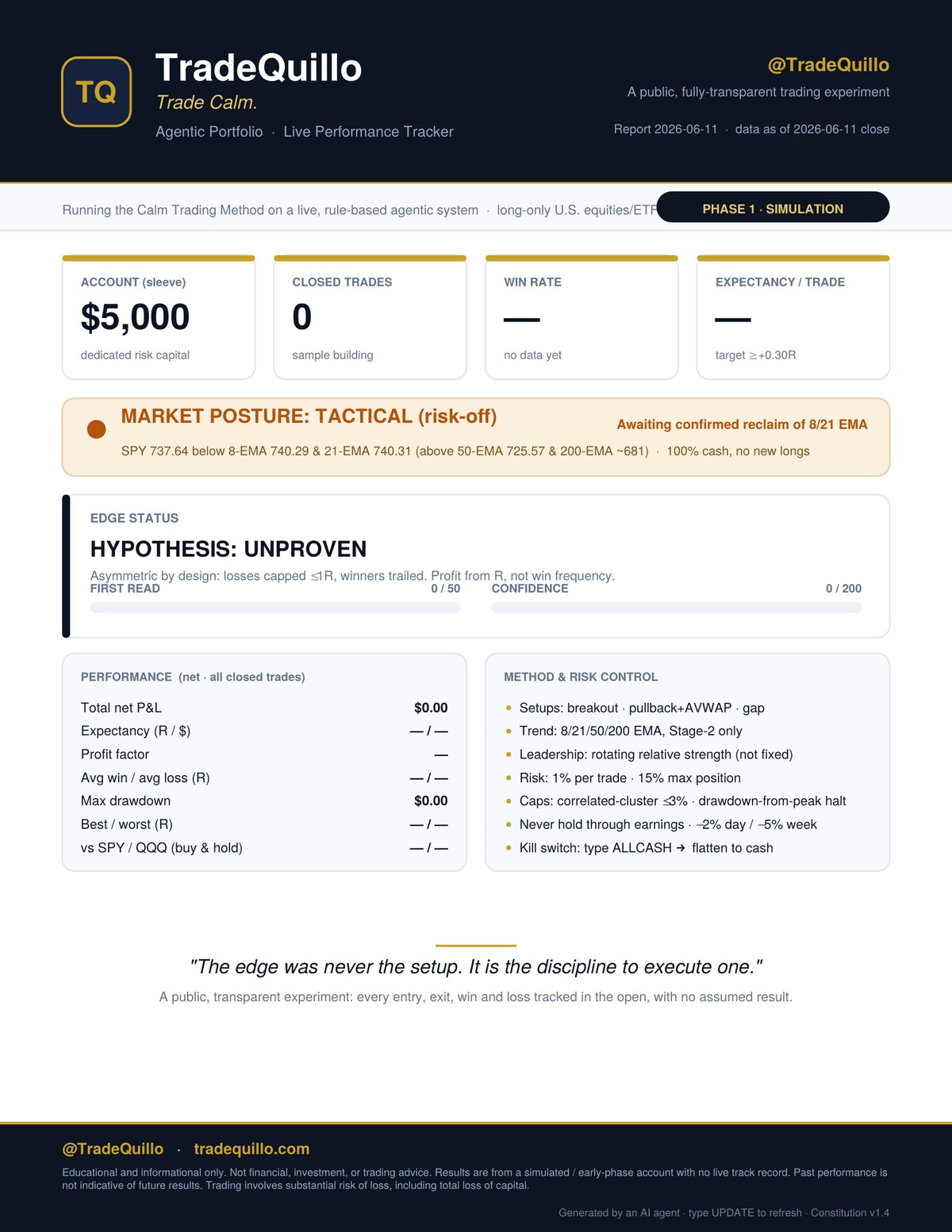
The system was constituted over a weekend, cold, in the wreckage of a brutal Friday: the market had just dropped 2.6% in a single session, a tech-led washout that hit hardest exactly the high-momentum names a system like this is drawn to. Its very first official decision, made before Monday's open, was to do nothing. That was test one: buy the crash because it looks cheap. Not taken. The posture gate read the tape as defensive, and defensive means cash.
Monday offered test two: the bounce. A green morning, our kind of names up 4 and 5 percent by midday, every instinct screaming go. The system evaluates on closing prices, not on mornings, so it waited. The bounce faded into the close, and several of those same names finished the day red. Chasing the open would have meant being underwater by the bell.
Tuesday brought test three, the subtle one: the index looked calm while the leadership broke underneath it. Former leaders fell 8 and 10 percent in a single day, and the only green name on our entire watchlist was the defensive one. The temptation was to dip-buy the fallen favorites. The rules said broken structure is not a discount, it is a warning. The cash position never moved.
Wednesday was test four: a binary. The hottest inflation reading since 2023 landed before the open and the market fell another 1.6%. The system was flat into the number by rule, because a written clause forbids opening fresh risk into the teeth of a scheduled binary event. There is no skill in guessing an inflation print. There is only exposure or no exposure, and we had none.
Wednesday's close also set up test five, the knife-edge: the index finished the day 36 cents above its 50-day trend line, the level our constitution treats as a regime tripwire. One close below it and the system escalates into a formal regime review that raises the bar for any re-entry. The agent tracked that line to the cent, prepared both branches in advance, and flinched in neither direction. On Thursday the verdict came in: the line held, by 12 points.
Because Thursday was test six, the hardest one: euphoria. De-escalation headlines broke in the Middle East, oil fell hard, the market ripped, and the largest IPO in history priced that evening, with SpaceX set to begin trading the next day at a valuation north of one and a half trillion dollars. Our watchlist went vertical: names up 2, 6, 9, nearly 12 percent in a single session, some still climbing after hours. And the system, sitting in 100% cash, watched all of it and did not buy one share. The rules were unambiguous: a one-day event candle inside a still-broken structure is a chase, a brand-new IPO has no trading history and is ineligible by definition, and the posture gate does not flip on excitement. It flips on confirmed closes.
Five sessions. Six classic ways to make a mistake. Zero taken. If you want the week's lesson in three words: discipline is king.
I want to be precise about the cost, because the cost is the point. On Thursday we watched our own watchlist rip double digits and captured none of it. That stings, and the system does not care that it stings, which is exactly why it exists. Confirmation has a price, and we pay it knowingly, because the alternative, buying adrenaline inside broken structure, is how trading accounts die. If this turn is real, the system will buy the same leaders on confirmation, with structure underneath and exits predefined. If it is not real, we just kept our powder dry through one more trap.
And one more piece of honesty: a week of perfect discipline proves discipline. It does not prove edge. We still have zero evidence that this method makes money, because it has not yet placed a trade. That test begins when the market confirms a turn and the system actually deploys. The kill criterion will be waiting for the data either way.
What we learned in week one
Doing nothing well is a skill, and it is the rarest one in this game. Watching a machine calmly hold a line I know I have personally failed to hold in the past was uncomfortable and clarifying in equal measure.
The audience is a risk factor, so we wrote a clause for it. Posting is fully decoupled from trading: no trade will ever be taken, sized, held, or exited for content, and "in cash, waiting" is a complete, publishable status. This week, it was the only status.
The machine is also a failure mode, and we treat it like one. I verify its levels against an independent chart before approving anything, a full audit already caught and fixed real drift in the documentation, and the rulebook is now frozen so the measurement stays clean.
And restraint compounds. Every correct "no" this week makes the eventual "yes" mean something. A system that only knows how to buy is a slot machine. A system that has demonstrated it knows how to wait has earned the right to be tested on offense.
What happens next
A Federal Reserve decision lands next week, and the system will treat it the way it treats every binary: as risk to manage, not a signal to trade. No capital deploys into that event. After it, if and when the posture gate confirms a real turn on a closing basis, the system begins hunting its first entries, in simulation first, with every proposal, fill, stop, and exit published as it happens.
Judge it on three things. Did it stay disciplined? Did it produce measurable, positive expectancy over a real sample? And did it beat just buying the index? Anything less than all three means the experiment failed, and you will hear that from me directly.
The edge was never the setup. It is the discipline to execute one. In week one, the discipline held, six for six. Now we find out, in public, whether the method deserves it.
Follow along at @TradeQuillo. Watch it play out in the open.
If you want to find out where your own discipline actually sits, the TQ Assessment surfaces it in about fifteen minutes, the full system lives in the Complete Calm Trading Method, and the operating system underneath all of it is the book, Trade Calm.
James
Educational and informational only. This is not financial, investment, or trading advice. The account described is small and currently in a simulation/early phase with no established live track record. Past performance is not indicative of future results. Trading involves substantial risk of loss, including the total loss of capital. The system described is operated with the assistance of AI, which can make errors. Nothing here is a recommendation to buy or sell any security. Do your own research and consult a licensed professional before risking money.
Related posts